 Trezor
Trezor Suite lets you choose Bitcoin inputs before sending a payment
Trezor Suite's coin control lets you manually choose the unspent transaction outputs, or UTXOs, used as Bitcoin payment inputs. Each selection determines which received coins enter the transaction and which funding histories become visible together. The chosen value must cover the recipient amount and the network fee, with any usable remainder returning as change. Manual selection helps keep unrelated receipts apart or consolidate a chosen group of smaller coins. It doesn't make transactions anonymous or promise lower fees. Input count, spending scripts, output structure, and fee rate affect cost. Selection happens within the Bitcoin account you're spending from, so its total balance doesn't describe every spending choice.
Shared inputs expose a public connection
A normal Bitcoin payment records its selected input references together, exposing a connection between previously received coins. Observers can trace those references back to earlier transactions. Spending coins together supports an inference about common ownership, especially if someone already knows who controls a funding address. Including unrelated receipts can therefore expose more of your holdings than the recipient amount alone suggests. Manual selection limits which coins enter that particular public group, although other transaction details can still reveal information.
Coin control can't erase address reuse, a previously shared address, or an earlier combined spend.
UTXOs, payment outputs, and change
A UTXO is a specific unspent output from an earlier Bitcoin transaction, carrying value your wallet can spend. Coin control selects these outputs as inputs to a new transaction. This distinction explains why choosing a coin doesn't mean sending its entire value to the recipient.

The output an input spends
An input identifies an earlier output through its transaction identifier and output index. Spending consumes that output in full. Bitcoin doesn't leave a reduced balance inside the original UTXO; the new transaction creates outputs for the payment and, where applicable, change. A coin's displayed amount therefore describes available funding, while the recipient amount describes what you're paying.
Where the selected value goes
The selected input value funds the recipient outputs, any change, and the fee. Each part has a different destination.
Recipient payment
The recipient output pays the amount assigned to that address. Additional selected input value doesn't automatically increase that payment.
Wallet change
Suite generates a change address for a spendable remainder within your wallet. That remainder becomes a new UTXO, and the fee reduces the value retained overall. Change remains visible on the blockchain, even when its fresh address makes ownership less obvious. A new address doesn't sever the public link to the transaction that created it.
Manual selection in the Bitcoin Send form
The desktop Bitcoin Send form provides Coin control for choosing the account's available transaction outputs. A passphrase wallet has its own accounts, so the account open in that wallet determines the relevant coin list. Connect and unlock the device, open the funded Bitcoin account, and complete the Address and Amount fields. Opening Coin control reveals the available UTXOs for manual selection. Their combined value must support the proposed payment and fee. A selection based only on the recipient amount may leave insufficient funding for the transaction.
Turning coin control off returns Suite to automatic input selection. The automatically composed transaction may use different coins, so a previously chosen grouping shouldn't be assumed to survive that switch. Coin selection and the fee setting are separate controls: changing one doesn't establish an appropriate value for the other.
The mobile Bitcoin Send form also provides Coin control. Sending requires a device connection supported by the phone and wallet model.
Labels for identifying coin origins
Wallet labels attach recognizable context to accounts, addresses, and transactions, helping distinguish receipts before spending them together. Names describing a genuine funding source or purpose are more useful than an amount alone. Labels remain organizational data; renaming a coin doesn't alter its recorded transaction history. Suite Sync provides encrypted label syncing on supported devices, while Legacy labeling uses its own storage choices. Keep the labeling mode and its storage available if those notes guide future selections. Without that context, a displayed address and amount may be insufficient to recognize an unfamiliar receipt.
Why can more Bitcoin inputs increase the fee?
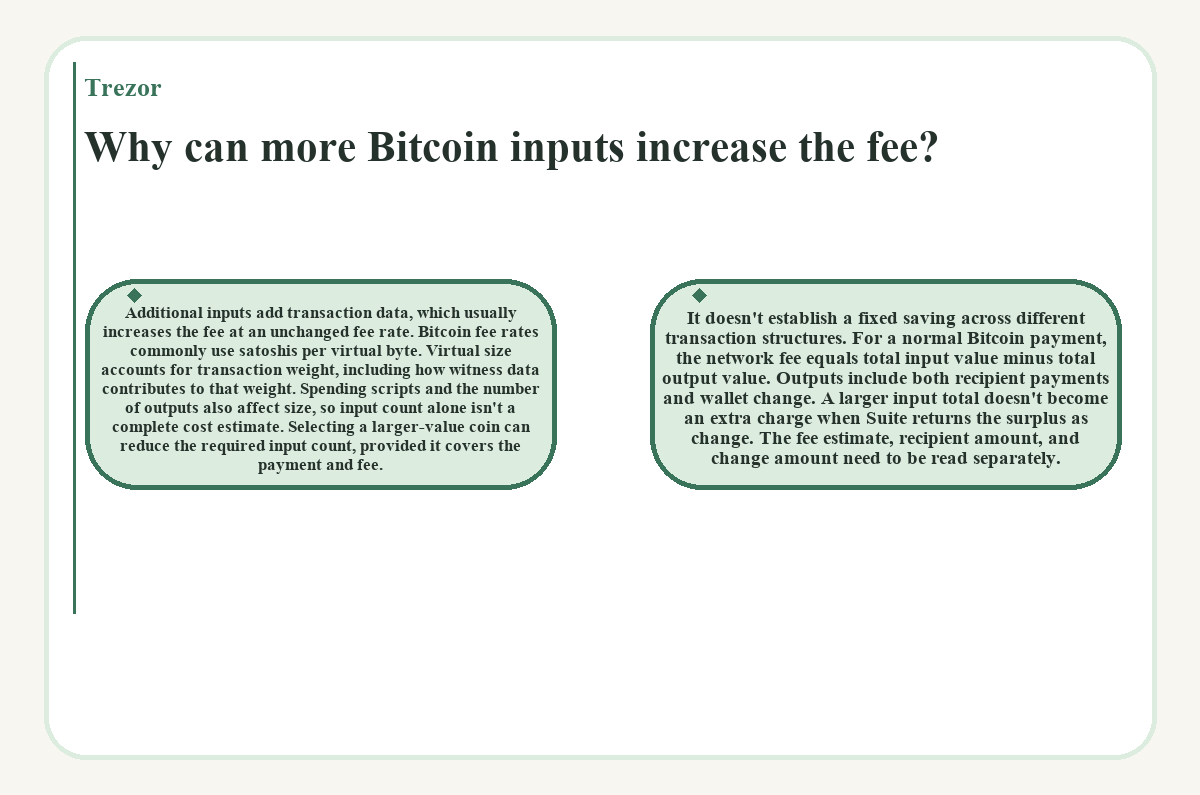
Additional inputs add transaction data, which usually increases the fee at an unchanged fee rate. Bitcoin fee rates commonly use satoshis per virtual byte. Virtual size accounts for transaction weight, including how witness data contributes to that weight. Spending scripts and the number of outputs also affect size, so input count alone isn't a complete cost estimate. Selecting a larger-value coin can reduce the required input count, provided it covers the payment and fee. It doesn't establish a fixed saving across different transaction structures.
For a normal Bitcoin payment, the network fee equals total input value minus total output value. Outputs include both recipient payments and wallet change. A larger input total doesn't become an extra charge when Suite returns the surplus as change. The fee estimate, recipient amount, and change amount need to be read separately.
Input choices for payments and consolidation
A payment can use one sufficient UTXO or a group of smaller outputs, with different fee and privacy consequences. Require the chosen coins to cover the payment and fee while excluding receipts whose histories should stay separate. Compare a single-input selection with a same-origin group using the same recipient amount, fee rate, spending script type, and output structure. Changing the input count then exposes the cost of consuming additional coins. Consolidating into one output requires sending the selected inputs' entire value, minus the fee, to that output.
| Spending choice | Purpose and trade-off | Inputs and resulting outputs |
|---|---|---|
| Automatic selection | Suite chooses funding; the selected group may differ from your preferred grouping. | Wallet-selected inputs cover the payment and fee, with change where applicable. |
| One sufficient UTXO | Funds a payment without combining additional received coins. | One input covers the recipient output, fee, and any change. |
| Same-origin input group | Funds a payment from a chosen group; additional inputs increase transaction data. | Several selected inputs fund the recipient output and any change. |
| Selective consolidation | Combines chosen coins for later spending; the transaction publicly connects them. | Several selected inputs become one wallet-controlled output, less the fee. |
| Full account consolidation | Combines the account's spendable coins, exposing their shared spending history. | All spendable inputs in the account become one wallet-controlled output, less the fee. |
The send preview supplies the fee estimate for each proposed selection. Under matched script and output conditions, the single-input payment generally needs less transaction data. The grouped payment consumes several old UTXOs and may return a single change UTXO to the account. Neither choice guarantees a particular confirmation time. Check the actual selected coins as well as the estimated fee before proceeding.
Consolidation costs now and changes later spending
Consolidation is an on-chain payment to your own receiving address, combining selected UTXOs into a larger output. Its network fee is paid when the transaction is included in a block. Later payments may need fewer inputs because the earlier coins have already been combined. Whether this reduces total fees depends on future spending patterns and the fee rates when each transaction occurs. A lower fee rate reduces the immediate cost of consolidation. The transaction still carries each input's data.
The public connection survives later transfers. Keeping unrelated groups apart can preserve boundaries while consolidating within each group, subject to any existing links.
What happens when selected Bitcoin inputs don't cover the total?
An insufficient input selection can't fund the recipient amount plus the network fee, even when the account holds additional coins. Coins left outside the selection don't contribute to that transaction. Adding another input raises the available value and also adds transaction data, so the fee estimate can change. Reducing the payment amount is another way to alter funding requirements. The resulting recipient output must still satisfy applicable output rules.
Suite offers estimated fee options and a custom fee setting. A lower fee rate can reduce required funding, although it may leave the payment waiting for network inclusion. Fee estimates describe network conditions and the proposed transaction; they don't reserve space in a future block.
Small unknown receipts and dust limits
An unfamiliar tiny Bitcoin receipt can be intended to help an observer link addresses when it's spent with other coins. Coin control lets recognized receipts stay separate from that output. The tiny deposit doesn't itself reveal a private key, and moving it isn't necessary to clear the wallet. Combining it with familiar coins can create the connection its sender is watching for.
Dust thresholds and uneconomical inputs describe different constraints. A node's dust policy can block relay of a payment creating an output below its threshold. Its threshold depends on the output script and the configured dust relay fee. An existing small UTXO can instead be uneconomical to spend because the fee its input adds outweighs its value. A single satoshi cutoff doesn't describe both situations.
Device approval, broadcast, and the spent-coin record
Signing on the device approves the prepared transaction; broadcasting submits it to the Bitcoin network for propagation and possible confirmation.
The hardware display shows the transaction details the device signs. Compare the recipient address, amount, and fee with the intended payment. An address label can't establish that a destination belongs to the intended recipient, and manual input selection doesn't fix an incorrect destination. The device also doesn't decide whether combining the selected funding histories meets your privacy needs.
On desktop, Review & send opens the review and signing flow, followed by Send to broadcast. A signed transaction can still be abandoned before broadcast. Once submitted, a pending status means blockchain inclusion hasn't happened yet. Device approval doesn't establish that miners accepted the payment or that the recipient has credited it.
After confirmation, the original selected outputs are spent and their references remain in the public record. Any spendable change is a new UTXO with its own output reference. The original receiving address can therefore be empty while the account balance still includes a Bitcoin change output.
Trezor: reader questions
How does coin control help with an incoming Bitcoin payment that's stuck?
Coin control can fund a child-pays-for-parent transaction by selecting an available output from the pending incoming payment. The child pays a fee intended to make confirming the combined transaction chain worthwhile for miners. The child can confirm only if the parent is included in the same block or an earlier one. This adds another transaction and its fee; it doesn't replace the incoming payment or promise immediate confirmation.
Does manual input selection replace Suite's Speed up feature?
Manual input selection chooses funding outputs, while Speed up submits a higher-fee replacement for an eligible pending outgoing transaction. The latter uses replace-by-fee, or RBF. It addresses a transaction already submitted to the network. Choosing different coins in a fresh send form doesn't automatically replace an earlier payment, and sending again without a valid replacement can create a second payment.
Will Bitcoin coin labels return after restoring the wallet backup?
Label recovery depends on the labeling mode and access to its stored data. On Trezor Safe family devices, Suite Sync encrypts synced labels with keys derived from the wallet backup, allowing recovery when the corresponding synced data remains available. Labels kept only locally need their separate files. Legacy labeling also depends on its selected storage, so wallet recovery alone doesn't recreate missing notes.
Can several Bitcoin recipients share one coin-controlled transaction?
The desktop Send form supports adding recipients while choosing transaction inputs with Coin control. Each recipient receives a separate payment output, funded by the combined selected inputs. Their amounts and the network fee must fit that funding. Additional outputs add transaction data, and recipients appear together in the public transaction. Separate recipient labels don't separate their on-chain payments.
Is there a network fee for changing Bitcoin inputs before sending?
Editing input selection in an unbroadcast send form doesn't incur a Bitcoin network fee. It changes the proposed transaction and can change its estimated fee. The fee becomes part of the transaction offered to miners, with payment occurring if that transaction is included in a block. Changing a transaction already broadcast requires a different operation, such as an eligible fee replacement.
Why can one Bitcoin receiving address show several coins in coin control?
A Bitcoin address can receive multiple transaction outputs, each remaining a distinct UTXO until spent. Reusing an address doesn't automatically consolidate those outputs, so one address may correspond to several selectable coins. They already share a publicly visible destination address. Selecting only one still leaves the others unspent, although it can't hide their existing connection to that address.